Visible Impact: A St Vincent De Paul Case Study
UX Design student project
Project Outline
St. Vincent de Paul (Vinnies) is an organisation dedicated to fostering positive change & supporting individuals in need. Central to its mission are op-shops, serving as vital hubs for affordable and pre-loved items. The impact of the fast fashion industry has seen a significant increase in second-hand clothing needing to be repurposed and thus donated. Although this influx increases the availability of supply for the public, the quality of donations is a major concern and can end up costing the organisation in the long term.
Our teams solution, through a mobile web app, provides the user with a way to track the impact of their donations, helping to build trust & loyalty to Vinnies and lead to more desirable donations.

Team
Jeffrey Clarke
Donna Feng
Nicholas Sangster
Duration
4 week design sprint
(part-time)
Roles
Research
Data Synthesis
Ideation
Sketching
Wireframing
Usability Testing
UI Design
Prototyping
Tools
Figma
Figjam
Trello
Slack
The Problem Space
To begin our team set out to understand the consumer and resale market in Australia in order to discover any potential opportunities that may exist within the donation space.
The fashion industry is one of the highest polluting industries. It is responsible for an estimated 10% of global CO2 emissions.
7,500 tonnes of donations are illegally dumped around op-shops and bins each year, equating to $5.63 million in cost to charities to dispose of poor quality goods.
On Average Australians buy 27kg of new clothing and throw away 23kg of clothing.
Even with the increase of resale sites like depop, facebook marketplace, ebay and etsy, 52% of people are still purchasing from op shops.
It was already clear that exploring the donation space could provide opportunities for Vinnies to reduce expenses, minimise waste and alleviate landfill pressure.
Research Goal
To discover peoples’ behaviours and motivations when donating to and purchasing from charity stores and understand Vinnies impact on the community.
Discovery
To achieve our goal, the team conducted an intensive 1 week research sprint that involved.
Market Research/Business Analysis(SWOT)
Competitive/Comparative Analysis
18 User Interviews
9 Stakeholder Interviews
Contextual Observations
Market Research
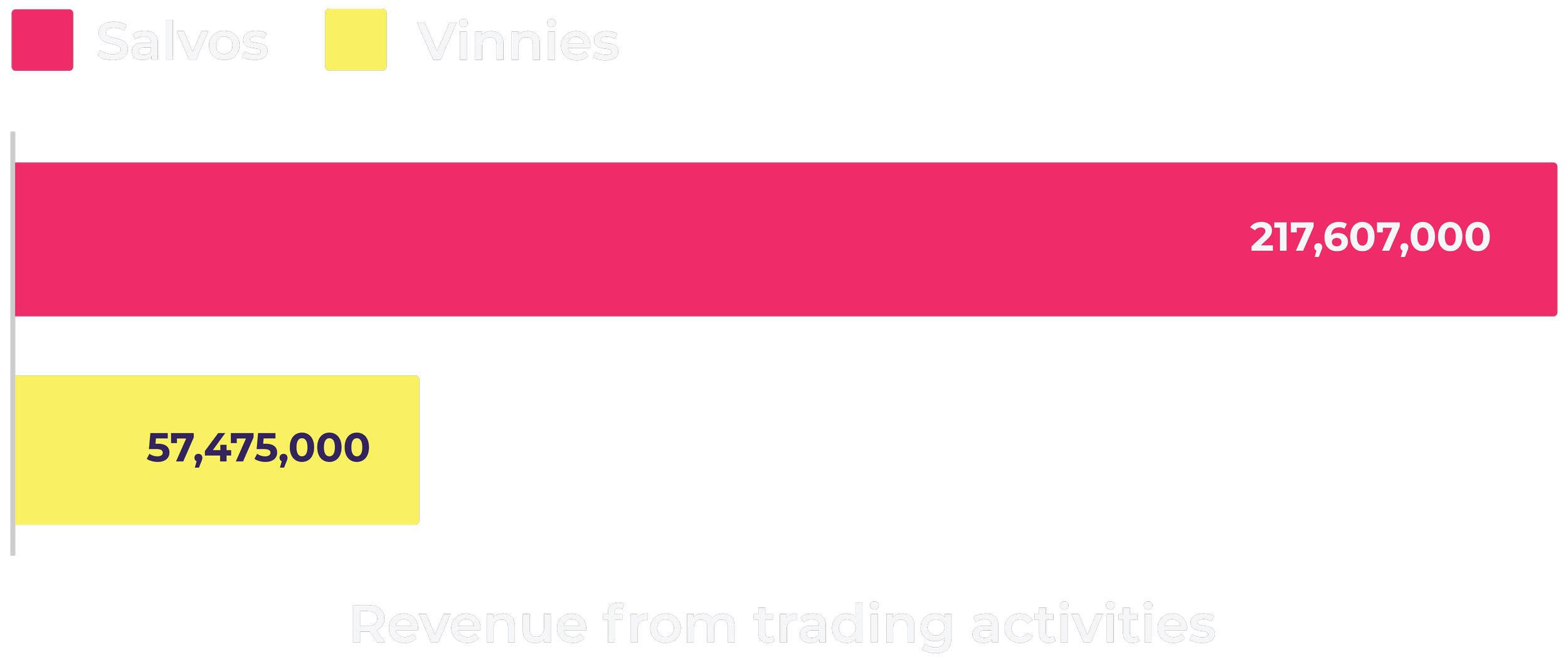
Vinnies stores grossed over $57 million of total NSW revenue in the 2021/22 FY, accounting for 29% of their total revenue.
In New South Wales, Vinnies distributed $12 Million in funds to outreach programs in the same financial year:
Financial and food assistance
Healthcare, including COVID-19 injections
Emergency relief for flood victims
Housing Assistance
Homelessness
Evaluating the client
Noting that Vinnies stores revenue was significantly less than their main competitor we conducted competitive and comparative market research in order to gain a better understanding of existing offerings in the industry.
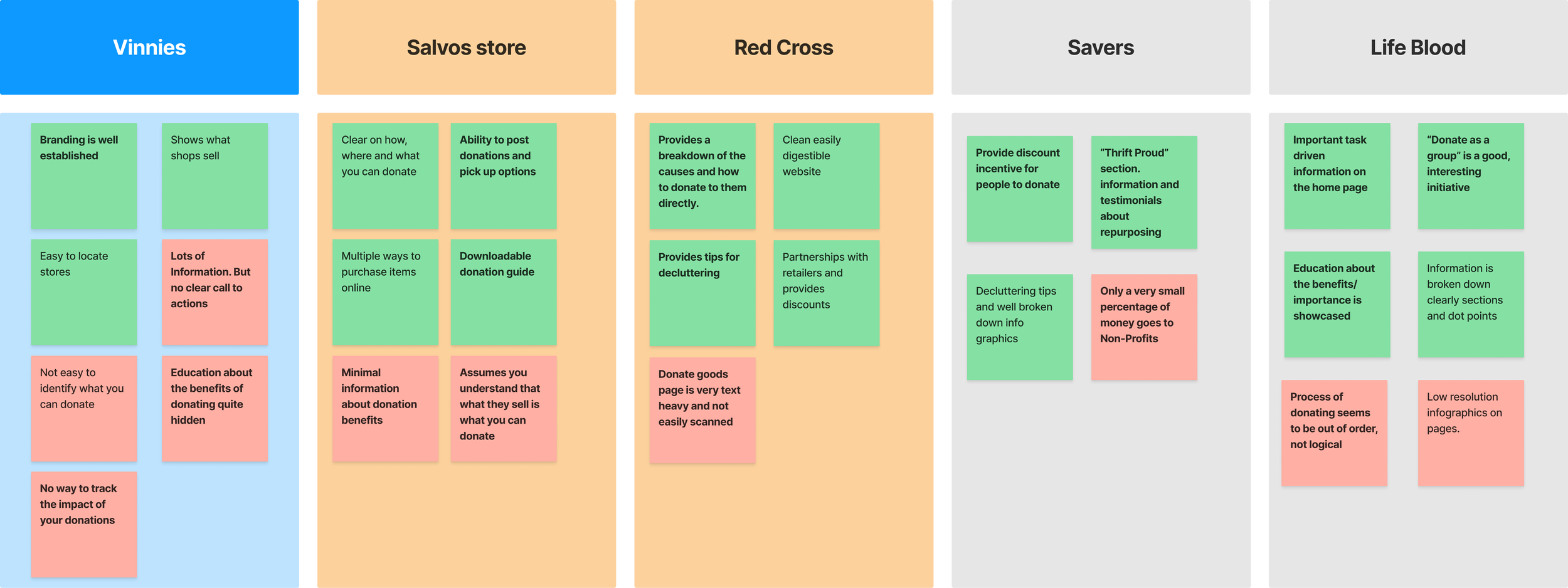
Due to the nature of the industry we decided to focus on what each business was doing well and what could be opportunities to improve upon, through a pluses & deltas exercise.
Vinnies
Despite having a well established brand with a wide reach in the community, education about donating was difficult to locate.
The Vinnies website is text heavy with no clear call to actions. actions
The Salvos Store
Is much more sales focused, rather than educational about the added benefits of a circular economy.
Provides a clear breakdown of what can be donated via a downloadable donation guide.
Red Cross & Savers
Both provide unique sections of information and testimonials regarding tips for decluttering and repurposing unwanted items.
Savers incentivises donations by offering a discount coupon.
Lifeblood
Showcases educational content about the benefits of donating and has interesting initiatives such as “Donate as a Group.”
SWOT Analysis
From the observations above and to uncover potential areas of improvement, we performed a strengths/weakness/opportunities/threats analysis of Vinnies.
The key takeaways were as follows:

Strengths
- Strong Brand recognition.
- Large reach in community.

Weakness
- No way to track the impact of your donations.
- Lack of educational content about benefits of donating.
Opportunities
- Educating the community about the additional benefits of donating.

Threats
- Revenue going to disposing of poor quality goods.
- Other high profile charities.
Understanding our users
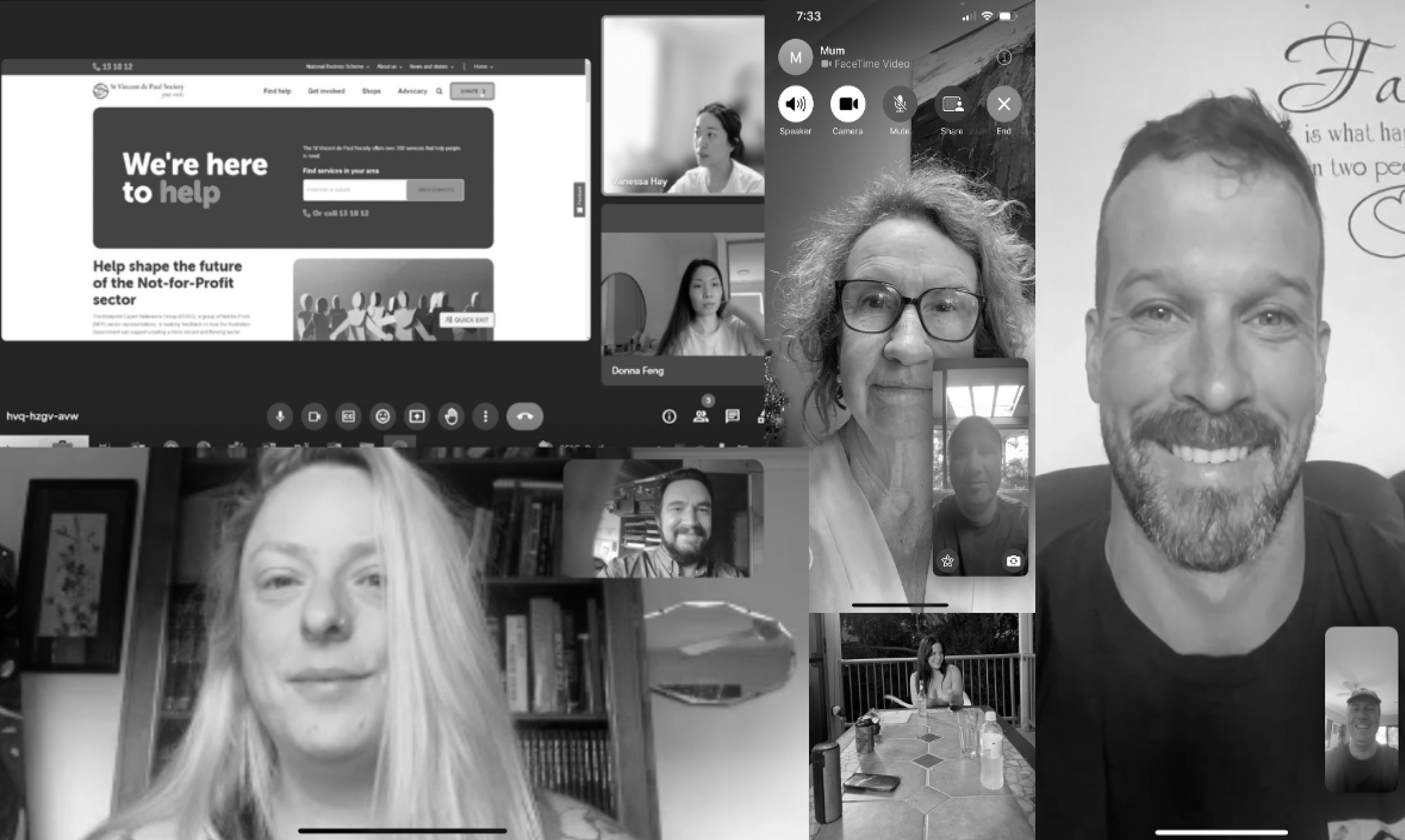
Understanding the motivations, behaviours and pain points of users in this space was integral to the creation of our primary persona. To achieve this we conducted user interviews, in store observations and spoke to staff & volunteers at both Vinnies and other charity op shops.
User Interviews consisted of 17 people both male and female, between the ages of 27 & 68. Focusing on people that donate (not just to op shops but as a whole) and purchase second-hand from op shops.
Understanding the business
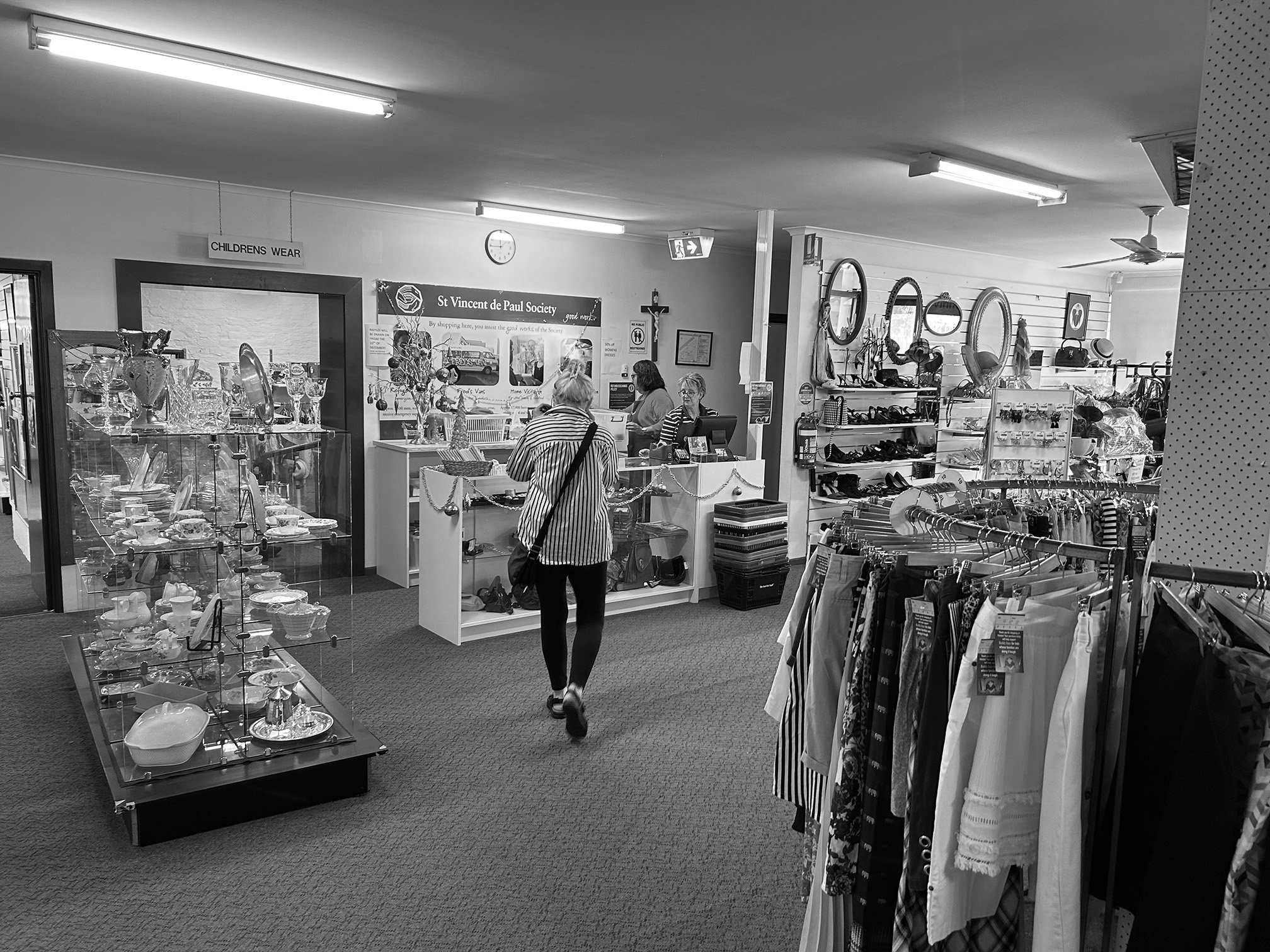
We visited 8 stores in person, where we spoke to 6 managers/owners and 3 volunteer staff.
During contextual inquiry we observed how these stores used signage and tags to educate customers, along with how donations were received and processed.
Define
What did we learn? - User Insights
In relation to the donation space we uncovered the following themes:
To Declutter - People donate clothes and goods seasonally to declutter.

To Help Others - People donate to help those who are less fortunate.

Lack of Knowledge - People are unclear about the donation process and lack trust in larger organisations.

In addition we found:
Interviewees donated to the most convenient location and tend not to specify one from another.
Interviewees donated goods that were usable and in good condition.
Interviewees dislike or disregard excessive marketing materials from charities.
Interviewees are frustrated by the lack of transparency from charities regarding the impact of donations.
Our assumptions that people don’t know how their donations benefit others and cannot measure how their donations benefit others was reinforced in our results, with many respondents stating that organisations lack transparency.
Stakeholder Insights at a glance
Although we had a strong foundation of knowledge regarding the problems our persona was experiencing, we had to understand the reality about how charity shops were currently run.
The majority of in-store charity workers at Vinnies were volunteer, senior retirees and in some cases living with a disability.
In-store signage was the only method of educating people about Vinnies initiatives and donation processes.
Charities spend a lot of time sorting through and disposing poor quality items that have been dumped outside of opening hours, at a significant cost to them.
Staff noted that there was a lack of knowledge among customers about pricing and people were often annoyed by the cost of items.
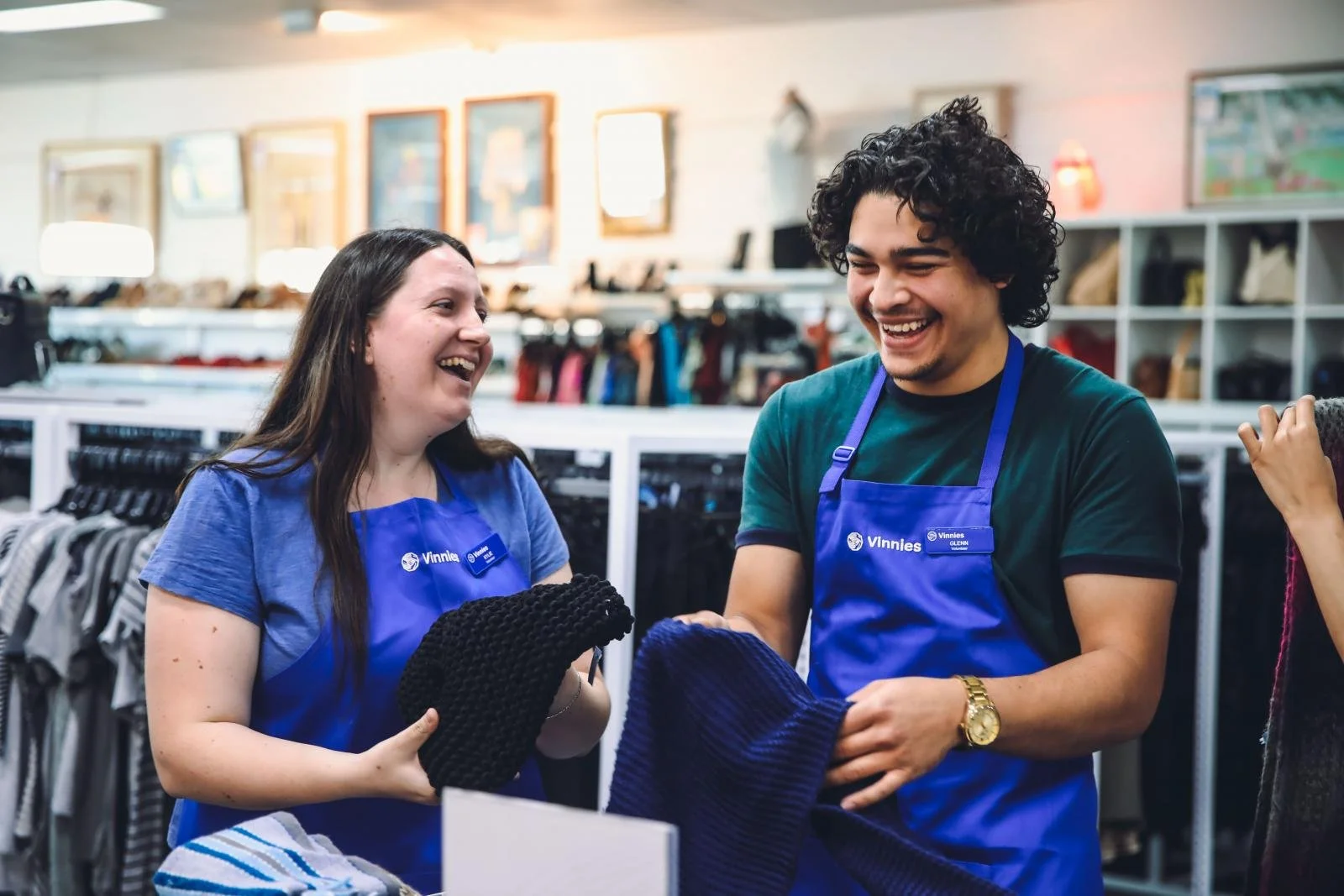
So who are we designing for? - Primary Persona
From the multitude of insights we gained, we wanted to empathise with our persona. It was becoming clear that their motivation to donate was not in question, but rather their need to understand what happens to their donations and exactly how their donations are impacting others, was of high importance.
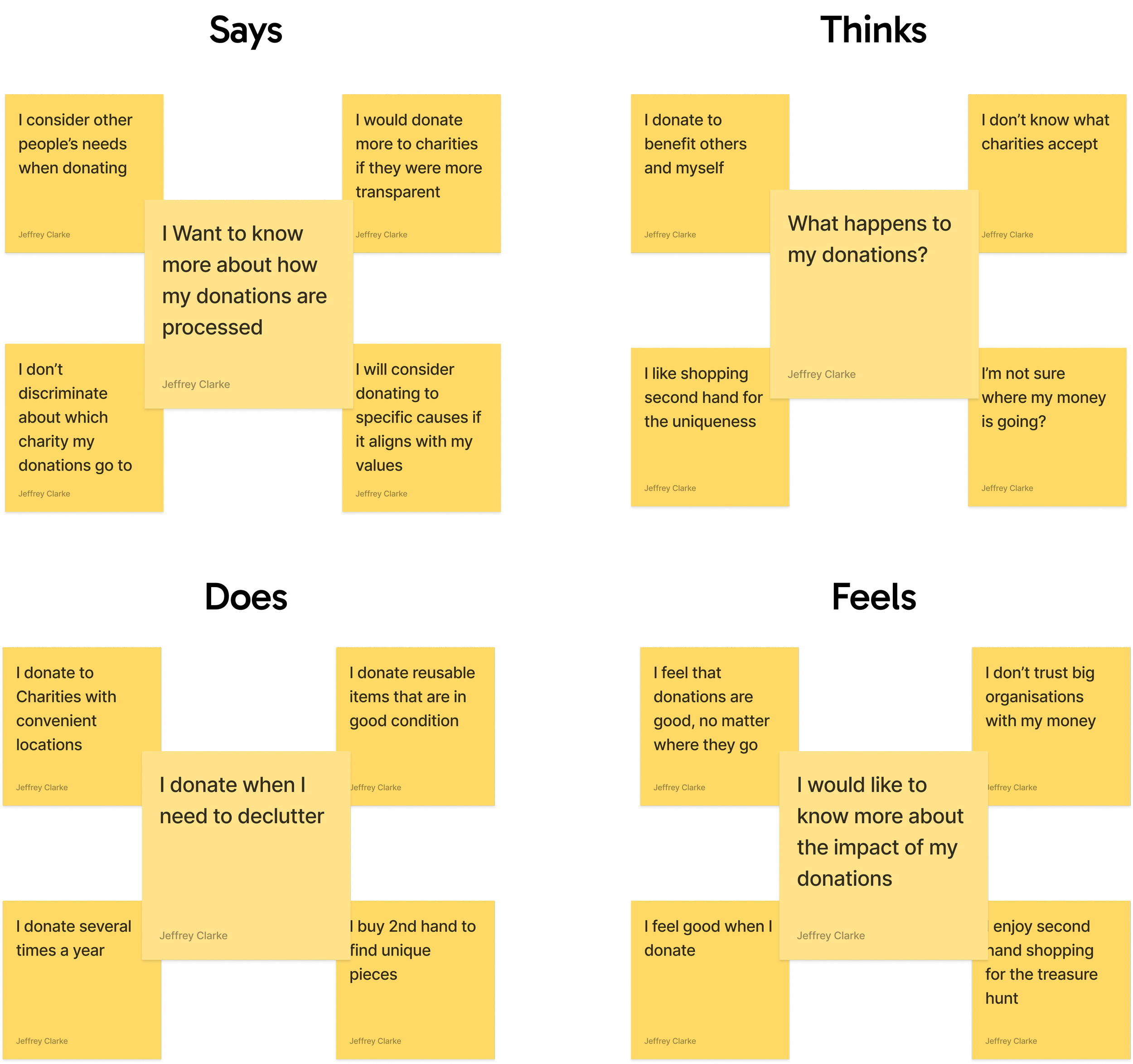
“I would like to know more about the impact of my donations”
By using this empathy map we were able to make a connection between the user and the problem space. We decided to move ahead with the creation of our Persona/Archetype.

Clare
The indiscriminate donor
Goals: To Declutter by donating unwanted items.
Needs: To help others by donating and to know how how donations are helping others.
Behaviours: Donates seasonally during routine decluttering to the most convenient location.
Pain Points: Frustrated by a lack of transparency from charities regarding the impact of donations.
Consistent - compassionate - inquisitive
Identifying Clares needs
As mentioned above, our persona, Clare, is confident in her ability to donate during her seasonal decluttering. She will donate usable clothes and drop them off at the most convenient charity store.
Therefore instead of focusing our problem statement on motivating her to donate more, we examined an initial problem statement around tracking and trust.
Clare needs more transparency around the donation process because she doesn’t trust charity organisations when she is decluttering and donating.
However, a team consensus, that our solution had to be more grounded in behaviour than sentiment around charity trust, was reached.
We wanted to make sure our problem statement hadn’t drifted away from what our research was telling us. By revisiting previous steps in the process we were able to devise our final problem statement:
Clare needs to know how charities use her donations because she wants to help others by donating unwanted items.
Develop
How Might We:
As a team we wrote two How Might We statements, which helped to rephrase the problem statement.
HMW establish loyalty to the Vinnies when donating?
HMW inform Clare about how charities use her donations to impact others?
We conducted ideation using the Crazy 8’s technique, creating 8 ideas in 8 minutes for each of our ‘How Might We’ statements.
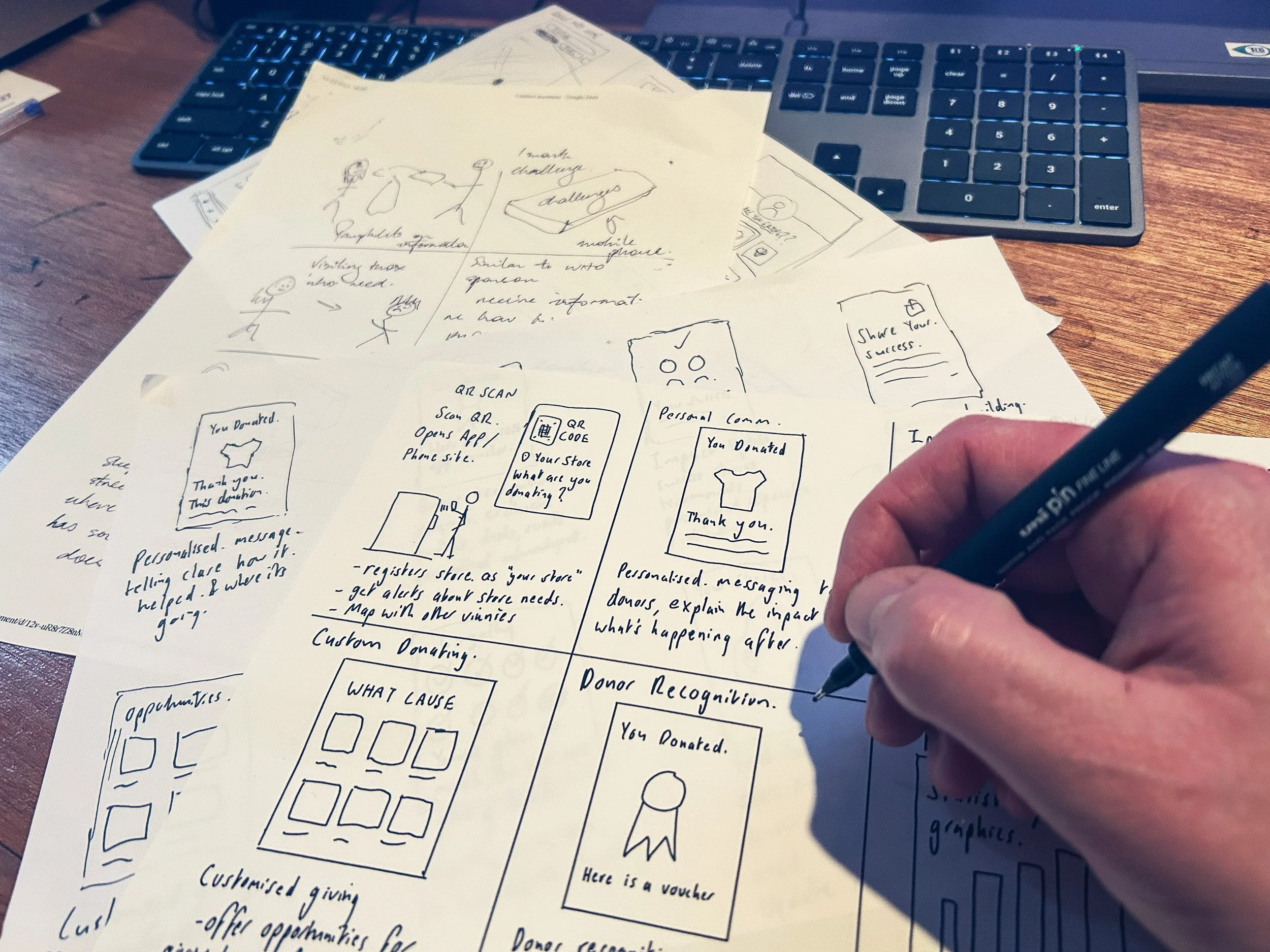
Our concept
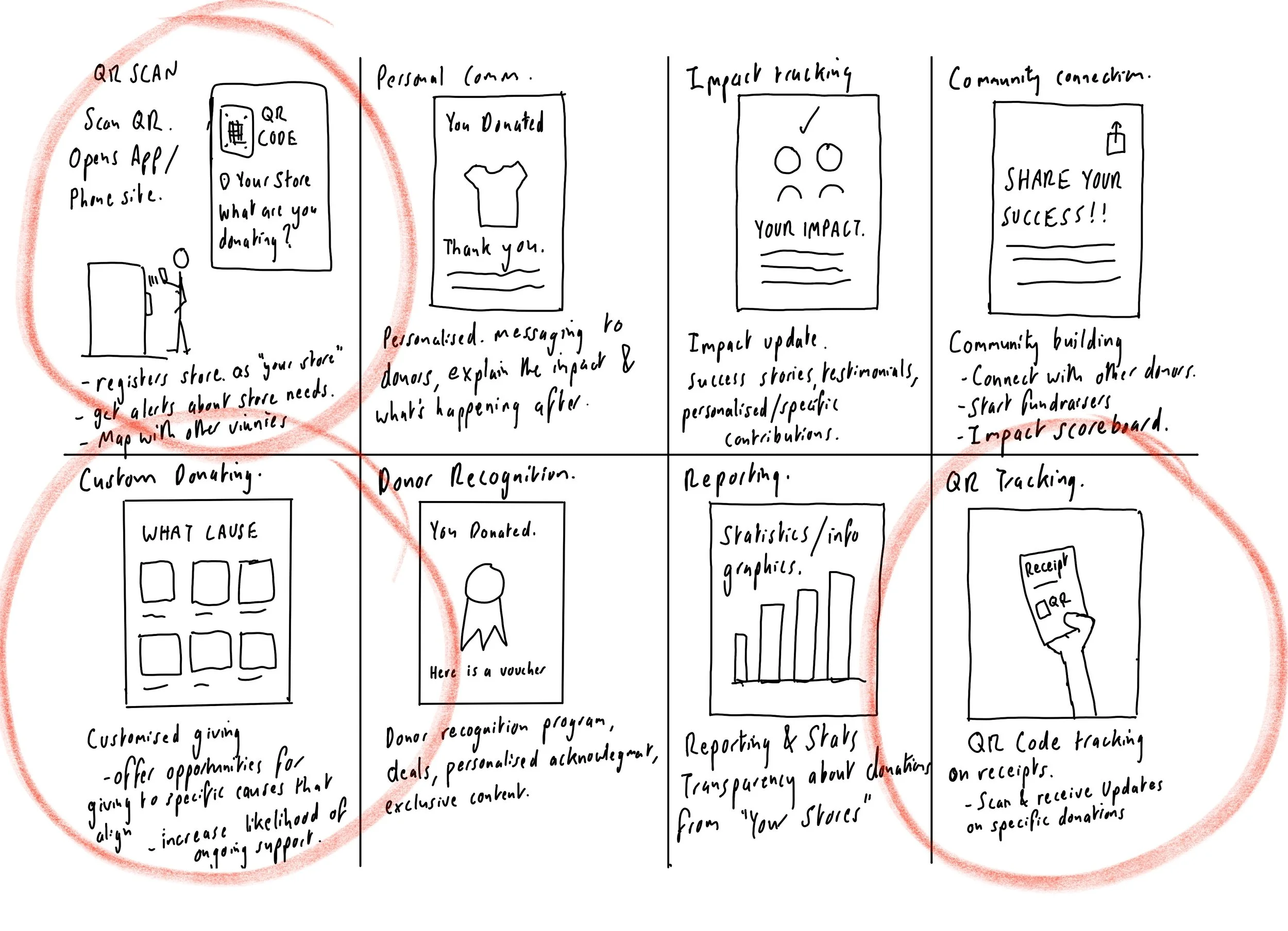
After combining and refining these ideas, through further rounds ideation, we decided on using a combination of our three ideas that met the needs of our persona, was achievable and could be impactful for the client.
An in-store QR code which when scanned, following a meaningful donation, links to a web app that provides Clare with opportunities to allocate points to specific causes and track her contributions.
BJ Fogg
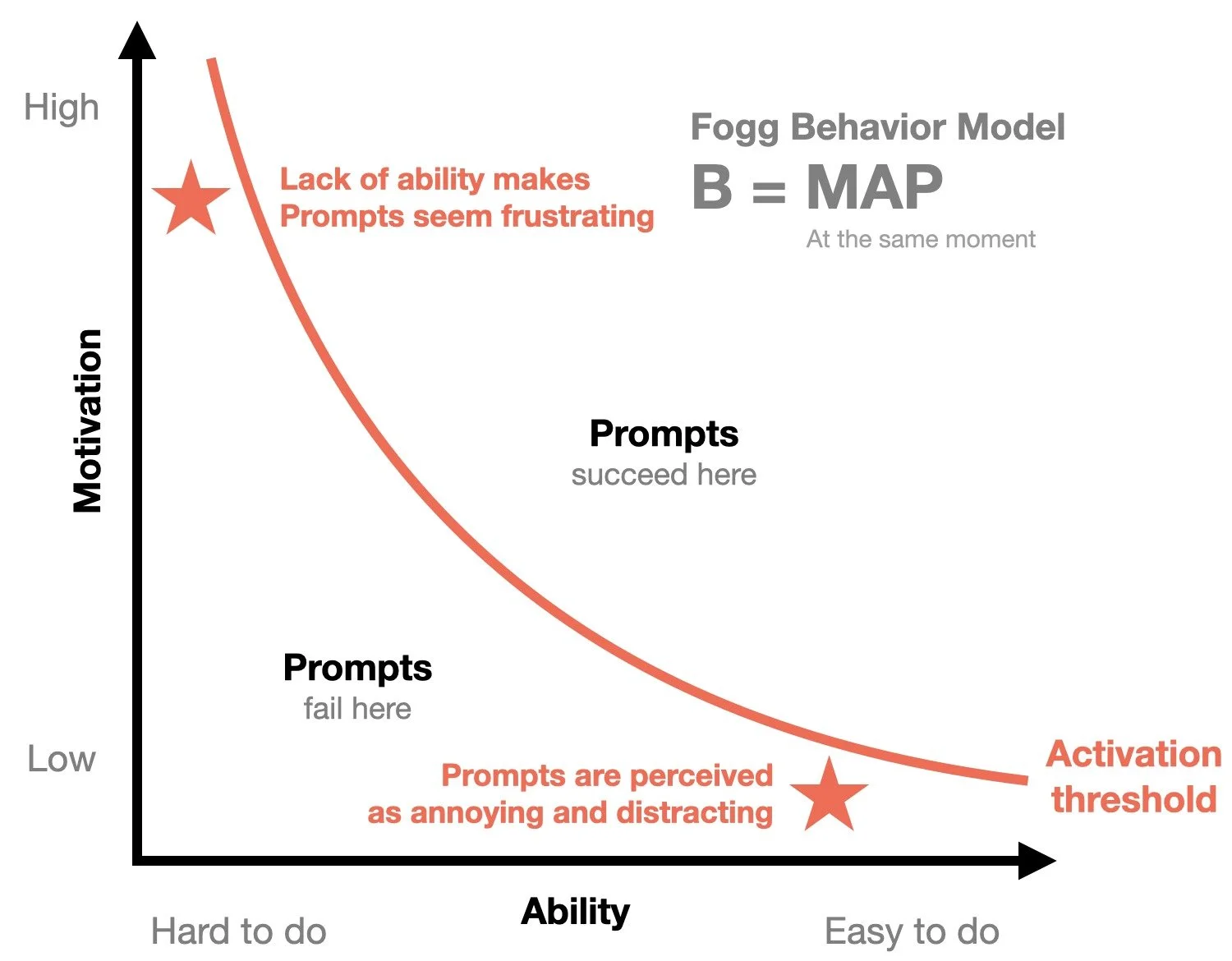
Before moving ahead we wanted to validate our idea in relation to BJ Fogg’s behaviour model, alongside the impact it may have for the client.
The model suggests that behaviour is a function of motivation, ability and triggers/prompts, with behaviour occurring when all three elements converge.
Motivation: Clare has a high motivation to donate to help others and declutter seasonally.
Ability: She already has the ability to donate to her local Vinnies.
Trigger/Prompt: When triggered by the web app we propose it will increase donation behaviour, specific to Vinnies, by providing her with the ability to track the direct impact of her donations.
Business Goals: Increased knowledge around how Clare is helping can lead to more desirable donations, loyalty to the organisation and ultimately increase sales for Vinnies.
So how do we build it?
The question we asked ourselves was whether to build a standalone app or create a web app that sits within the current Vinnies website? We ultimately decided on the latter, as it
Is a cost effective solution for the business
Speeds up the onboarding process for the user, by removing the need for installation.
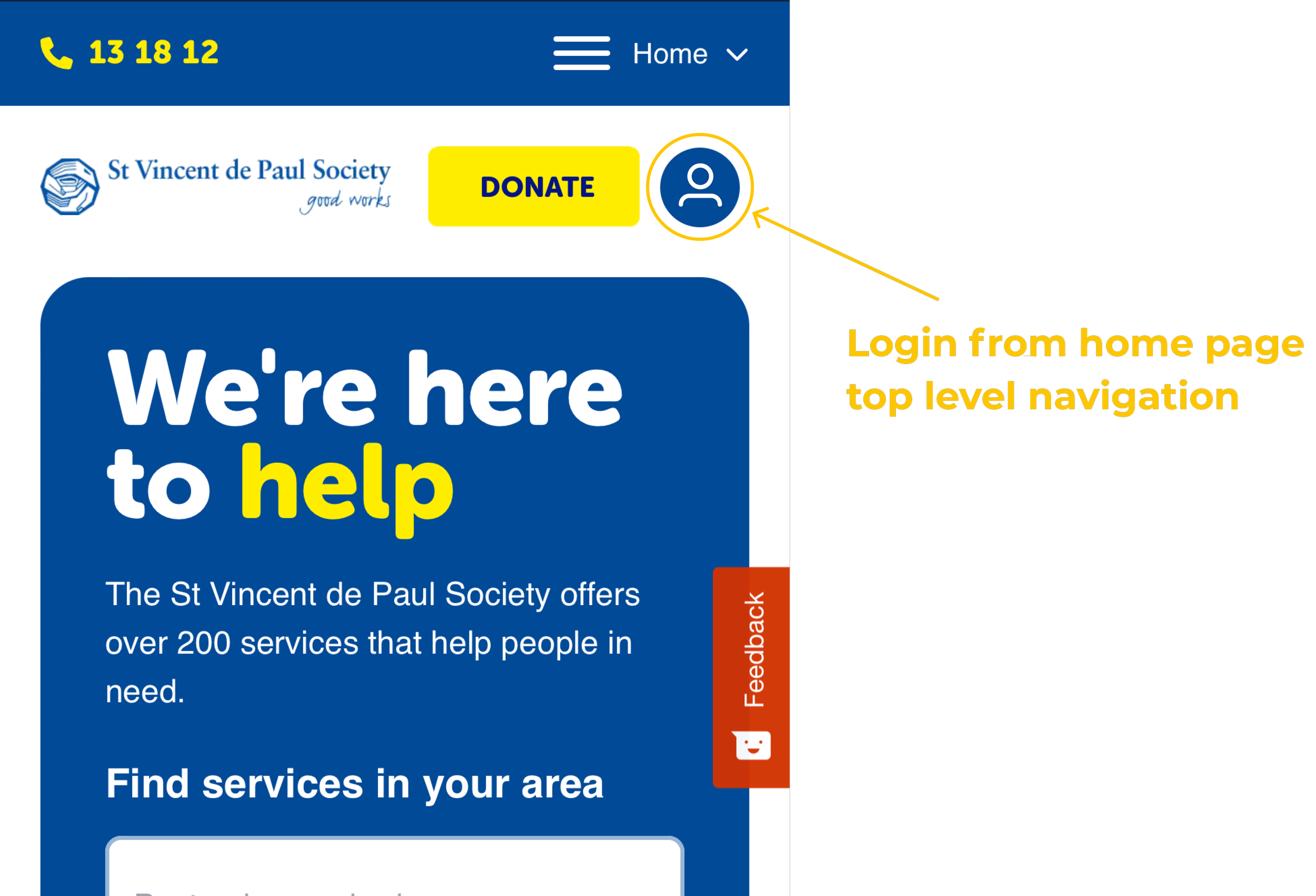
We sitemapped Vinnies.org.au to see where we might want our web app to sit. We wanted to it be easily accessible from the home page, sitting within the top level navigation.
Wireflow & Prototyping
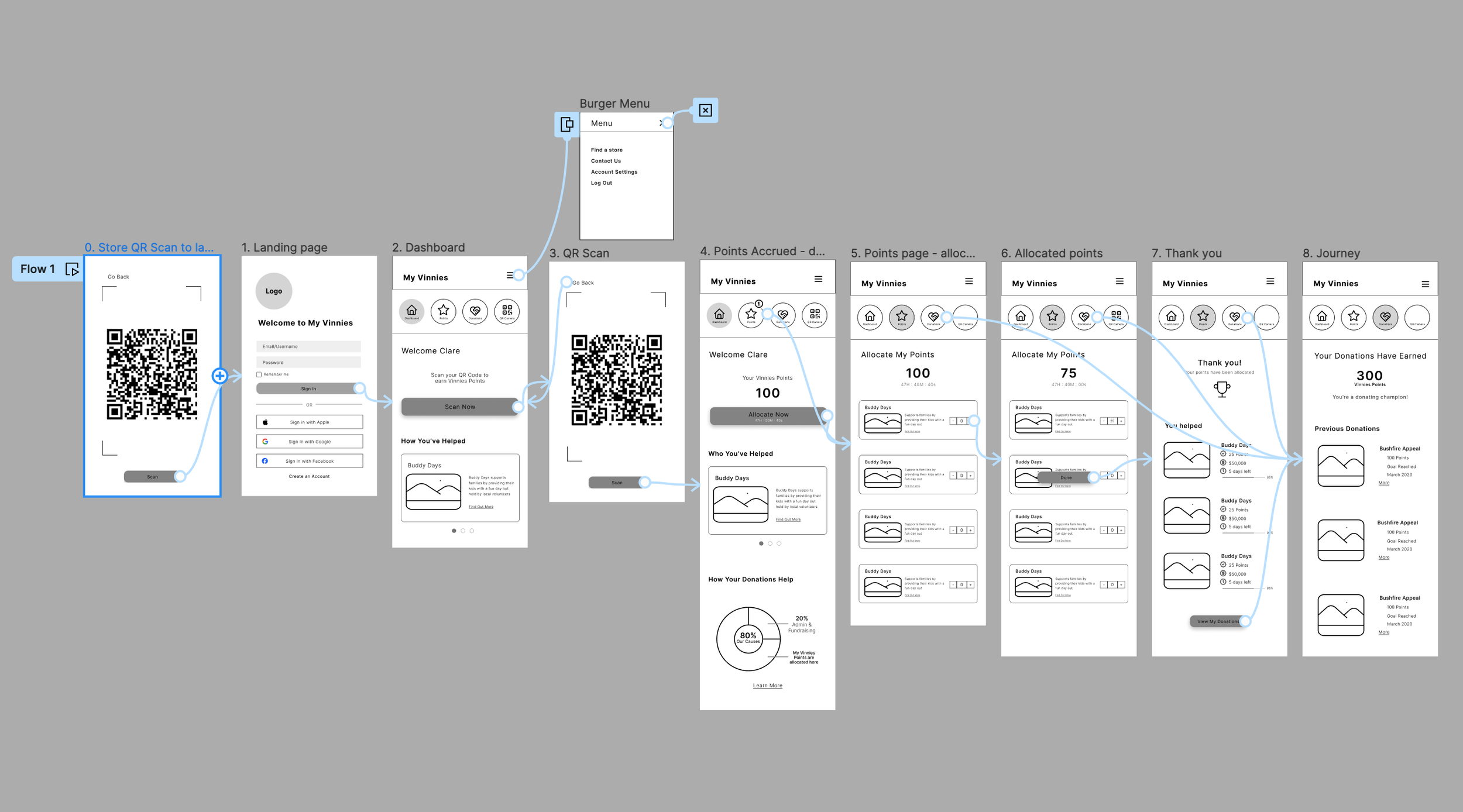
QR Code Screens - For initial onboarding and to add points to account.
Home/Dashboard - Where the user can learn more about specific Vinnies causes and initiatives. Along with a breakdown of where the money from the allocation of points go.
My Points - Where the user can see the points that have recently earned from donating and allocate them to causes of their choice.
My Donation Journey - Where users can view a history of accrued points and a breakdown of the causes that have been donated to over time.
The wire flow allowed us to understand Clare’s journey through the MVP and formed the blueprint for the creation of a testable prototype.
This helped us validate the logic behind our idea and address any issues that arose from the objectives of her journey.
From this flow we identified the following screens that would be necessary for a testable prototype:
A pivot
Our initial idea was to give half of ‘points earned’ to Vinnies to allocate to urgent causes or overhead costs, however when working through this flow together it seemed confusing that when earning 50 points for a donation, the user would only be able to allocate 25 of those points to causes of their choosing.
Initial Prototype
Testing our flow
Due to the high importance of content and wording throughout our flow we chose to create a low fidelity, grayscale, digital prototype to test with users, in order to avoid unnecessary confusion that can come with paper prototypes.
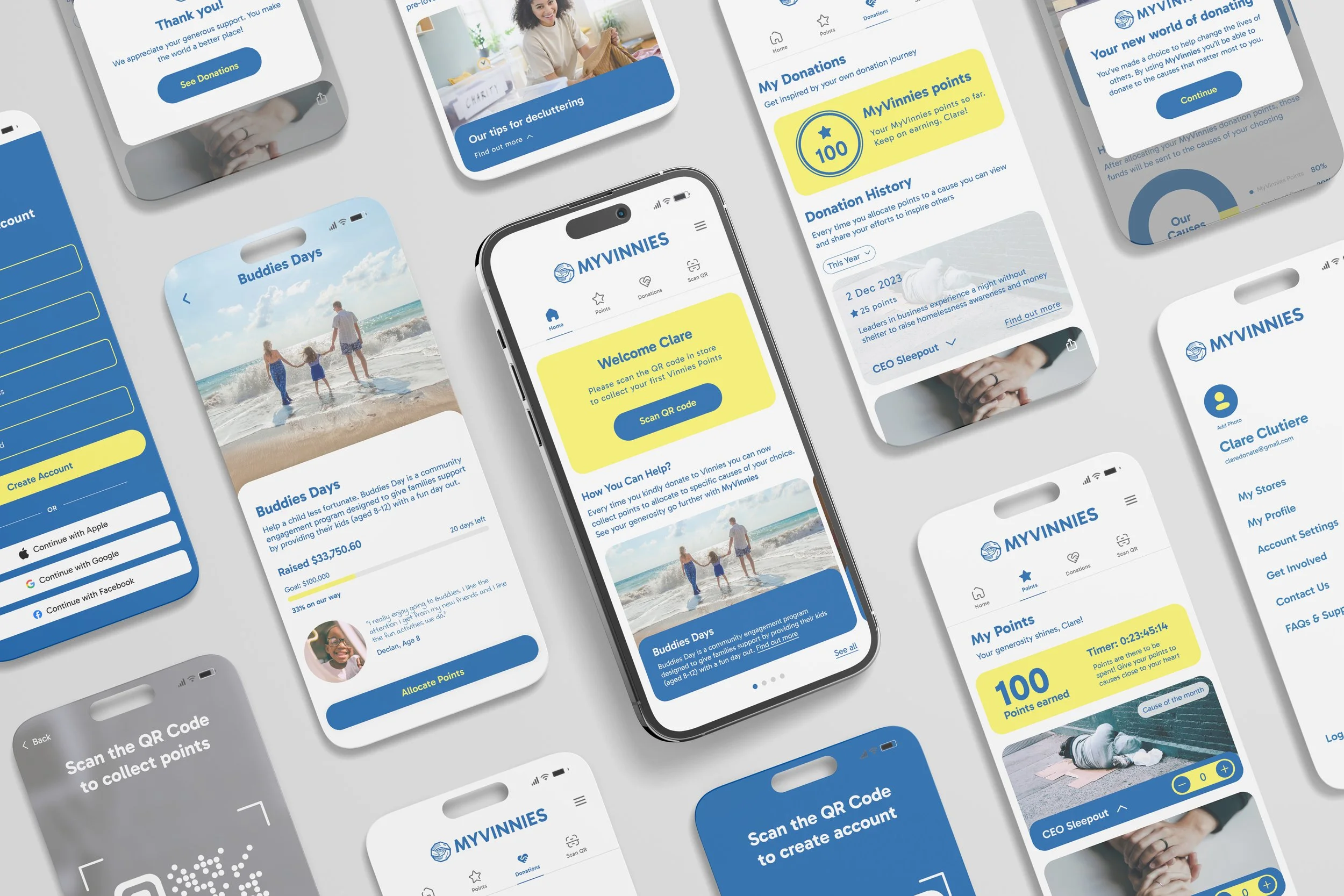
With this is mind the “MyVinnies” web app was born.
A personalised dashboard for donors to collect points, allocate them to causes that they care about and view how their donations have impacted others.
Using Figma the team tested our initial prototype using the following testing scenario:
“You have made a donation to Vinnies. Create an account, collect your donation points and allocate those points using the My Vinnies web app.”
Out of 5 people tested 3 of those users were unsure about the language and amount of points on the final “donations” page.
“Your donations have earned” seems confusing to me.
“Why do I have 300 points when I was allocating 100 earlier?”
Users also hesitated on the login screen as it lacked familiarity from a account creation perspective.
“Am I signing in or creating an account?”
Overall the feedback was positive in relation to the objective of the MVP, however we decided to compare onboarding UI examples from Dribbble and apps such as Airbnb for best practise.
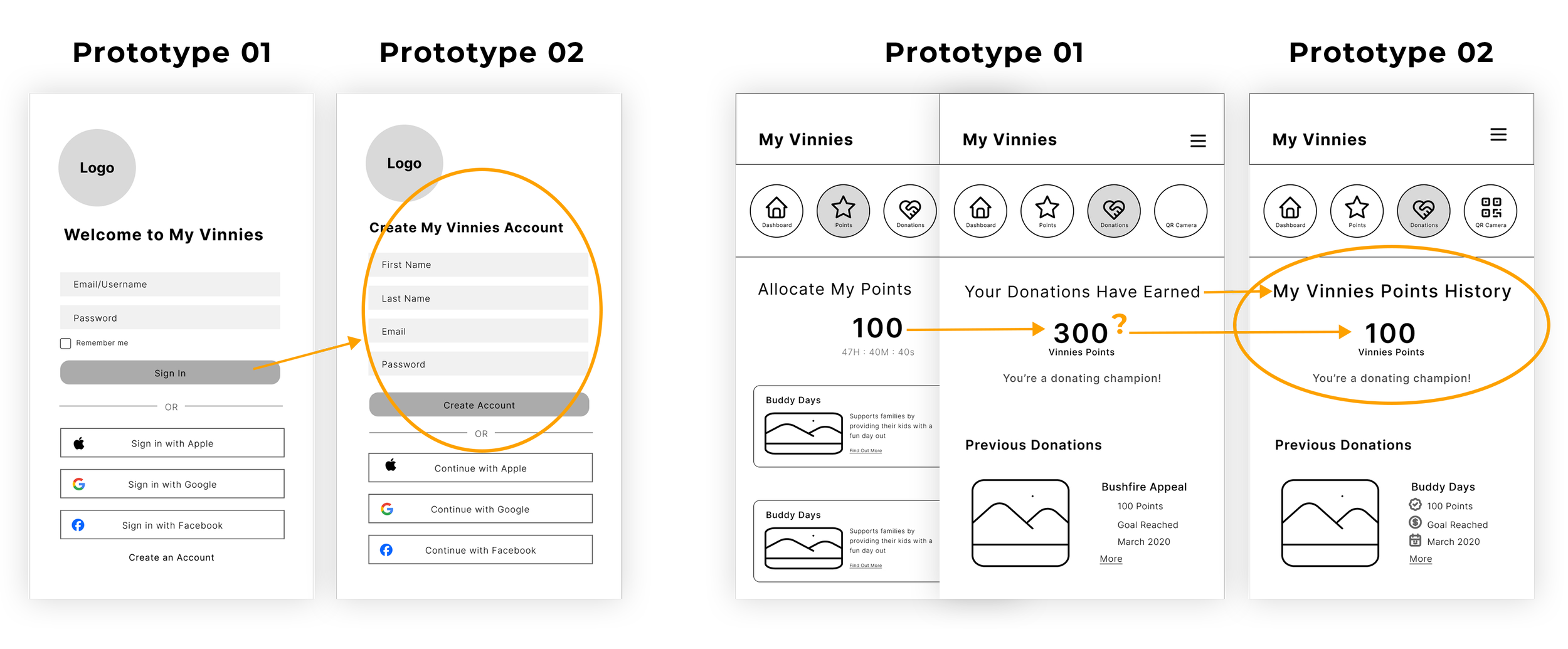
From our usability testing the made changes based on this feedback from our users:
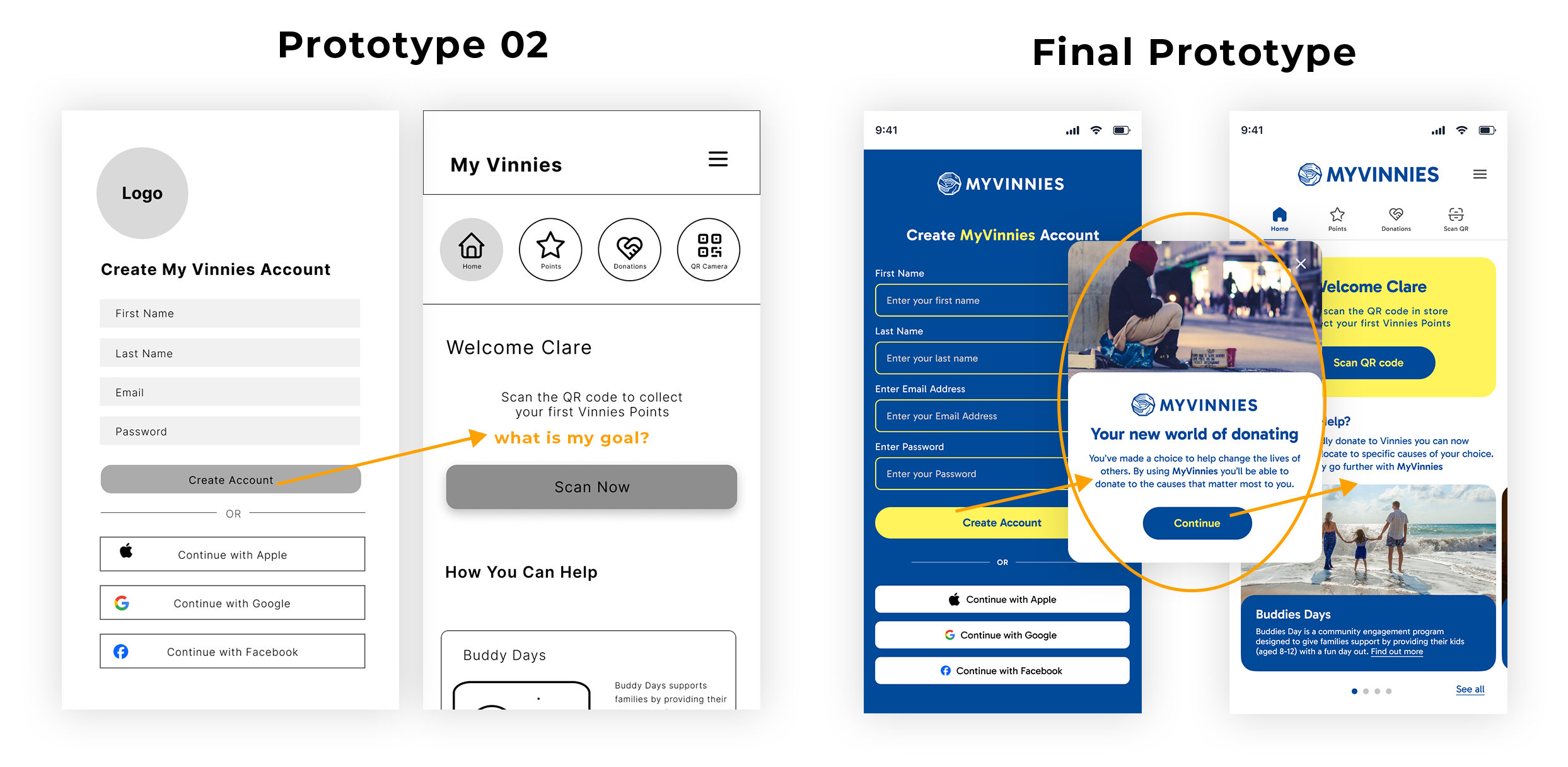
Created a standalone account creation page, to provide more clarity around initial onboarding.
Clear language change on the donations page and altered the amount of points to reflect the flow for a user who had made their first donations.
Further Testing
We retested again using mid fidelity, digital wireframes after making iterations to our initial prototype. From the 6 people we tested in round two, the feedback was extremely positive, with no major hesitations from our users.
The only concerns raised being that users felt there could be more explanation in regards to an introduction to the web app, especially if it was the first time using it.
To Alleviate this issue we created a pop up overlay to provide further information about the purpose of the web application.
We felt confident to move forward with a high fidelity prototype.
Stakeholder - Noting that staff were primarily volunteers we wanted to make the onboarding as seamless as possible without adding any undue strain on staff.
Persona - Clare chooses to donate in the most convenient way and wouldn’t always enter the store.
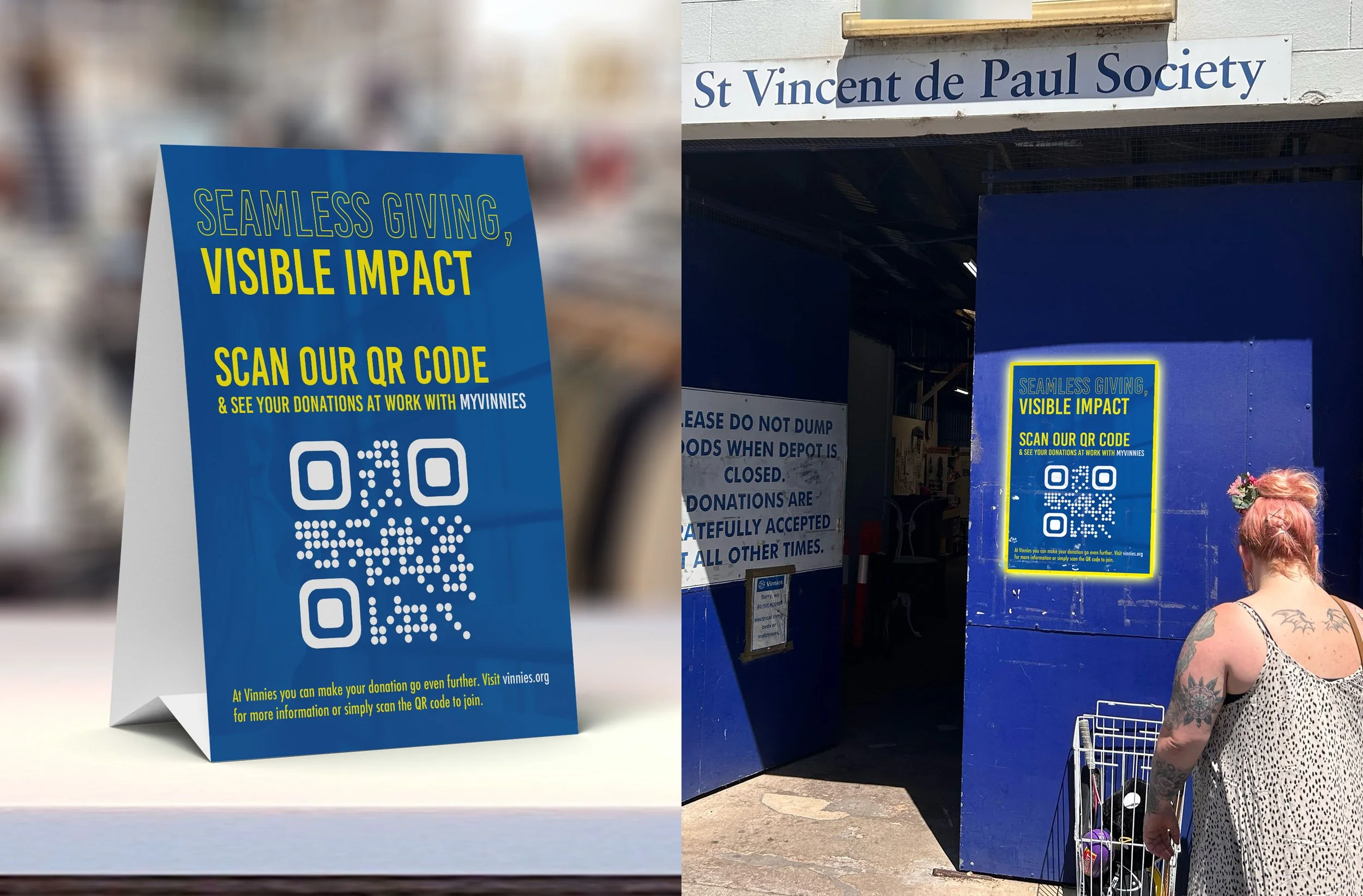
Signage - As mentioned in our observations, signage is a crucial aspect of educating customers in store at Vinnies.
Considering this we provided a visual of what in store and exterior signage might look like once implemented.
How will the user learn about MyVinnies?
Deliver
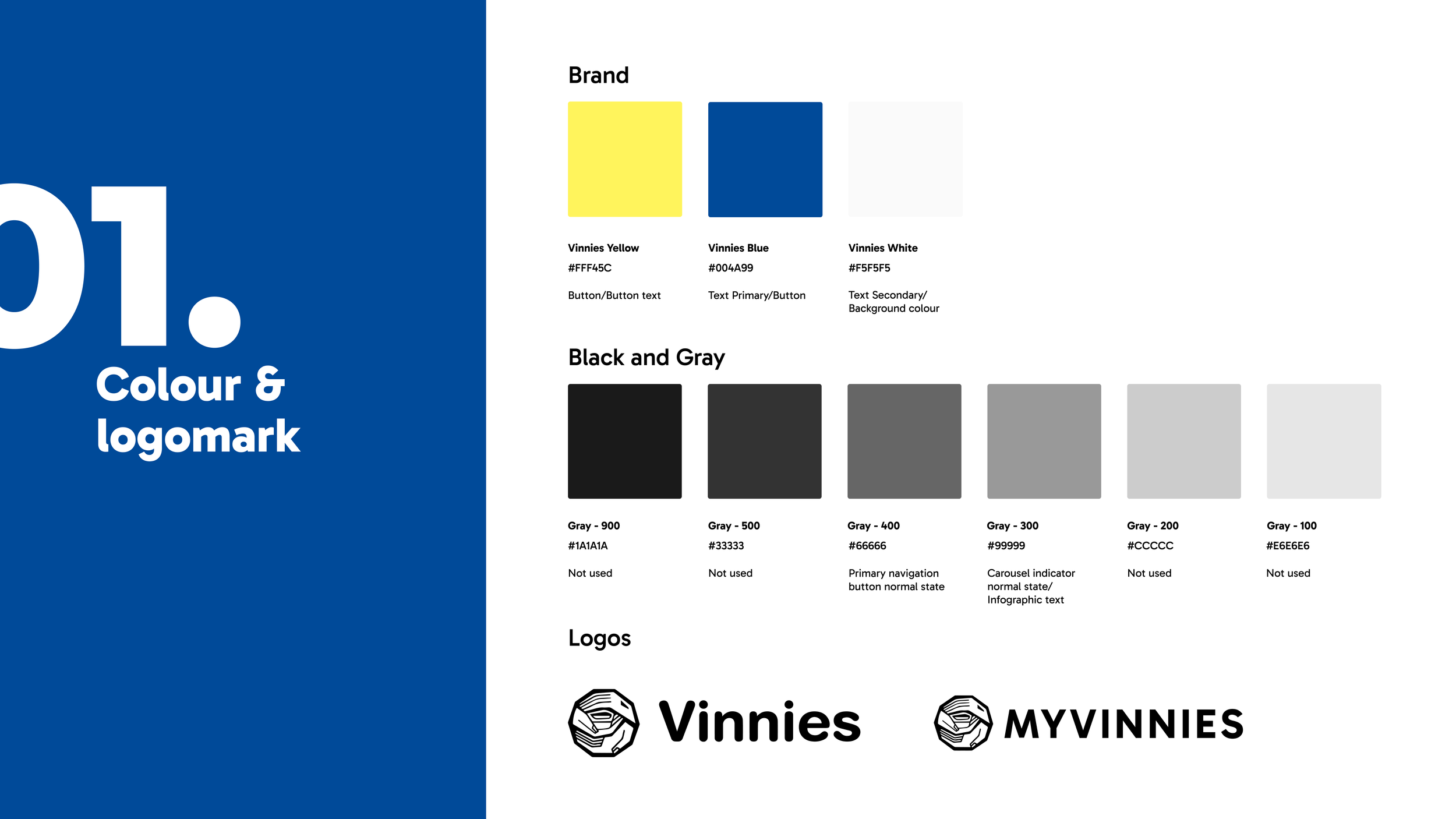
Knowing that our Hi-Fidelity MVP would sit within the current Vinnies.org.au website we wanted our final design to align with the current brand guidelines. To ensure consistency across all design elements we developed a rudimentary design system for our high fidelity MVP.
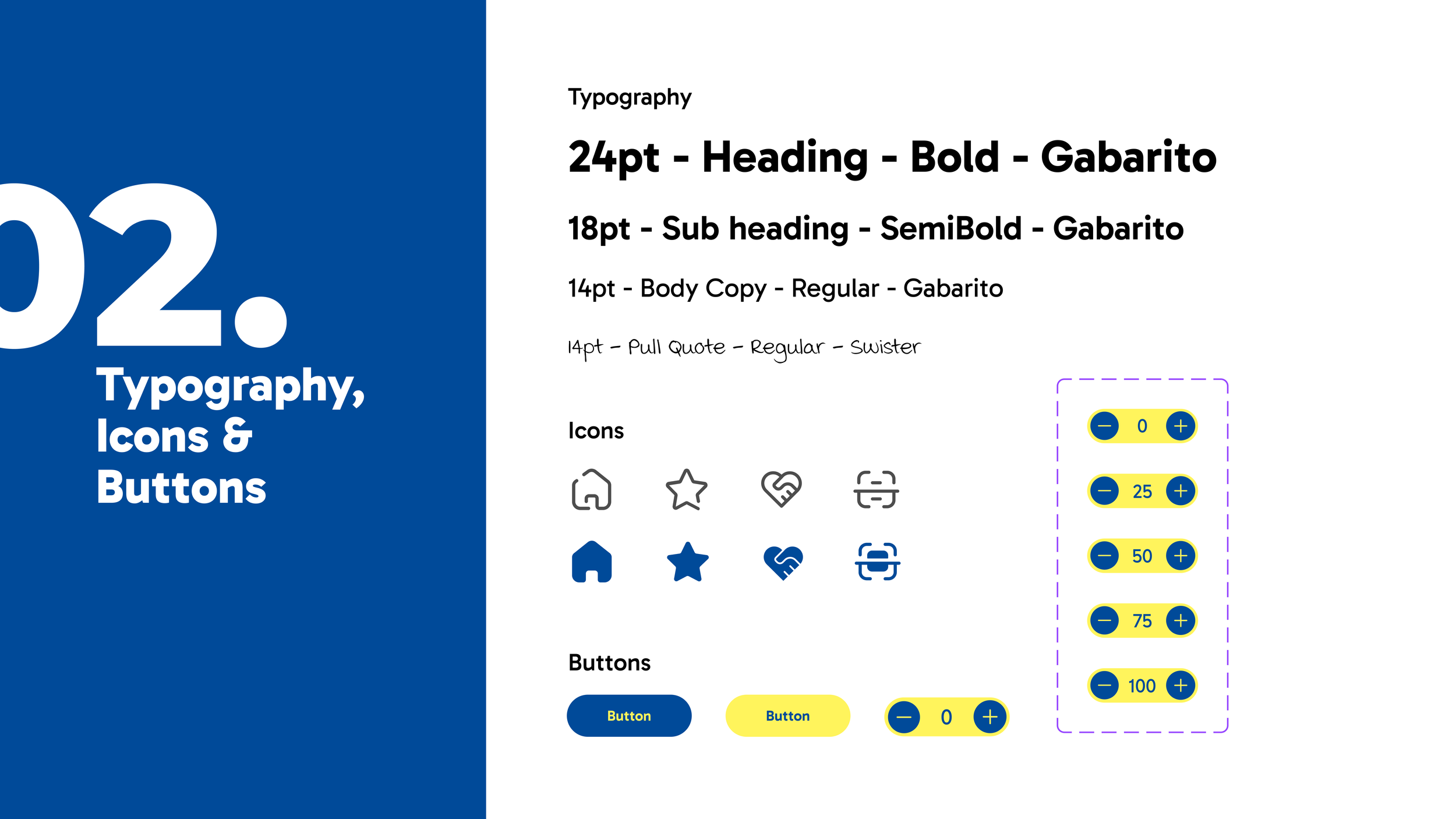
Hi-Fidelity MVP
Each team member had input in aspects of the final design of the our hi-fidelity MVP according to their strengths. Having a background in design I took the lead in several areas including:
Design system creation
Component creation
Onboarding and home page
Find out more (causes) page
Micro interactions
For our final design there were an number of iterations and additional features included in order to strengthen the solution for both our persona and the client.
They are as follows:
Declutter Sustainably: Decluttering being main motivation for our persona to donate, we included a section which provided tips for decluttering.
Infographic: Understanding how the organisations use her donations was something of high importance to our persona. An easily digestible infographic was used to convey this information.
Cause of the month: From our in-store observations we discovered that Vinnies have monthly causes.
Share Button: Our research showed that users often discovered reasons to donate through friends and family via social media. Social media sharing could provide increased exposure for the MyVinnies app.
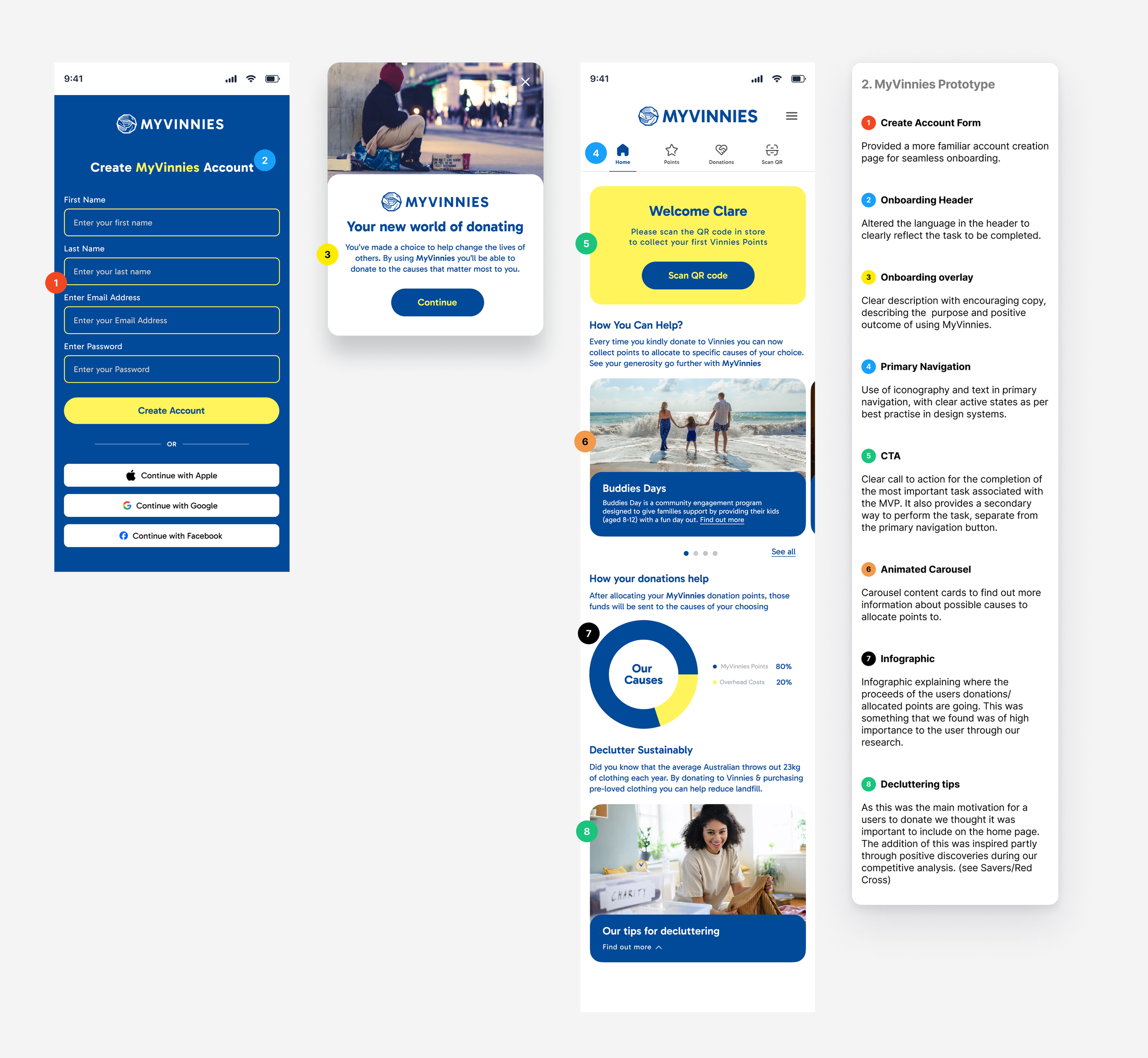
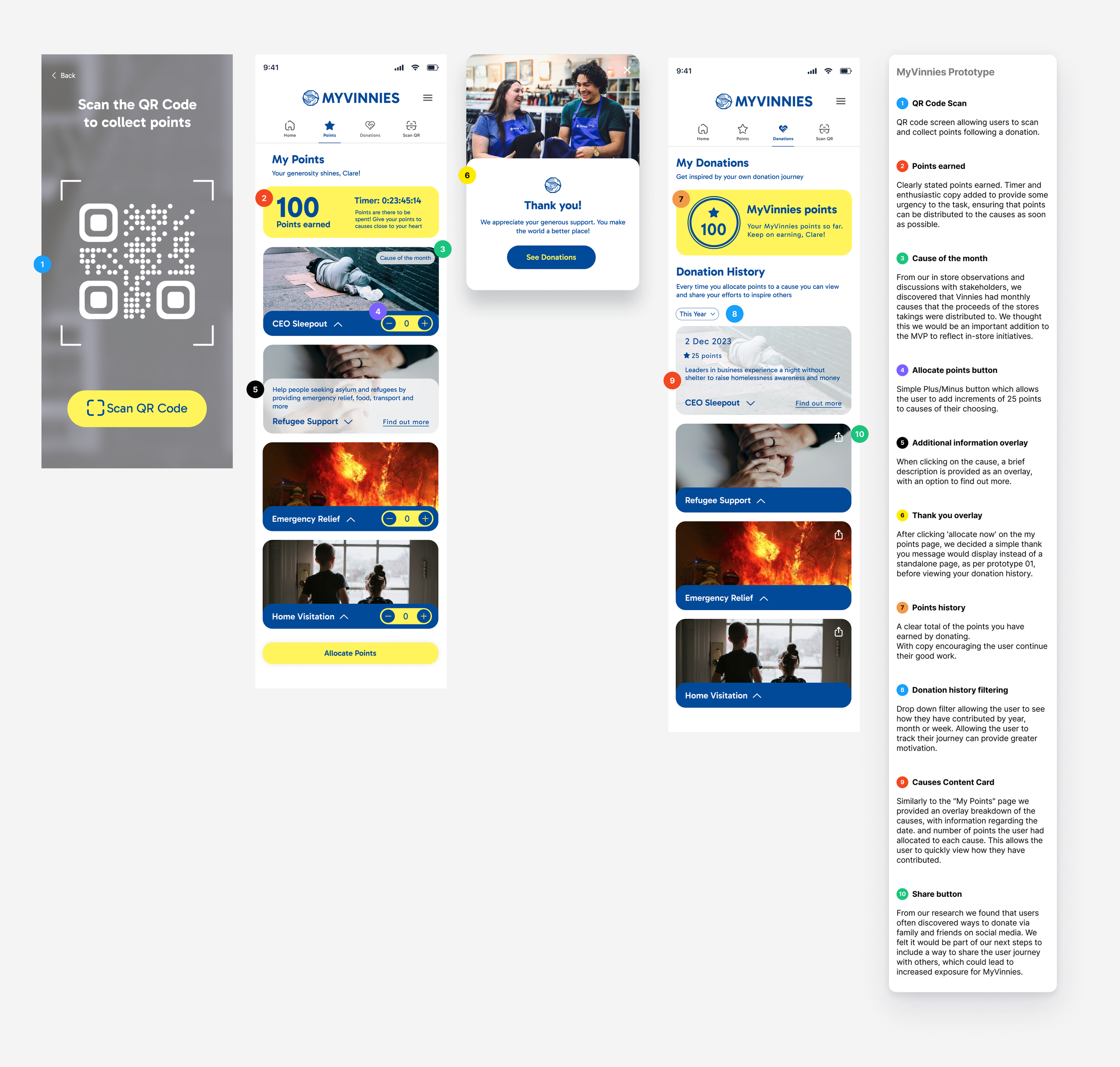
A walkthrough
Solution analysis

Resolving the problem space
Our solution encourages desirable donations during opening hours.
This can significantly reduce the dumping of poor quality goods outside of store hours and limit the amount of items going to landfill.

Improving the situation for Vinnies
Helping to reduce dumping outside of hours and encouraging desirable donations through the emotional trigger of MyVinnies, can reduce the amount of money Vinnies spend on disposing of poor quality items.
Greater transparency and ability to track the impact of your donations can lead to increased loyalty to Vinnies, not only when donating, but when purchasing pre-loved items.
The above mentioned will help increase sales and revenue for Vinnies and allow them to give more back to those in need.

Meeting the needs of our persona
Our solution meets the needs of our persona by providing her with a visible way of tracking how she is helping others.
Addressed her primary frustration by providing greater transparency about how the proceeds of her donations are being distributed.
Provided her with a way to give back to causes of her choosing.
Next Steps
MyVinnies Integration
If provided more time on this project our team would hope to create and implement, the flow from the current website, ensuring users can access their account via the homepage.
Further Development
Although we felt we met the needs of our persona, we did identify areas of further development. Such as providing a more interactive progress indicator of the users donation journey and expand further on ways to inspire others through social media integrations to use MyVinnies.
Build trust
Explore through further research and ideation ways to build trust in charity organisations, a common trend in our research that we felt was difficult to quantify during this project.
The collaborative experience throughout this project has been immensely rewarding. Working within a cohesive team of three individuals, we embraced a democratic approach underpinned by strong communication and a keen understanding of each other’s strengths.
These personal and technical competencies has undeniably played a pivotal role in our collective success and I am looking forward to building on this for the next project.
Thanks for reading!
Reflection